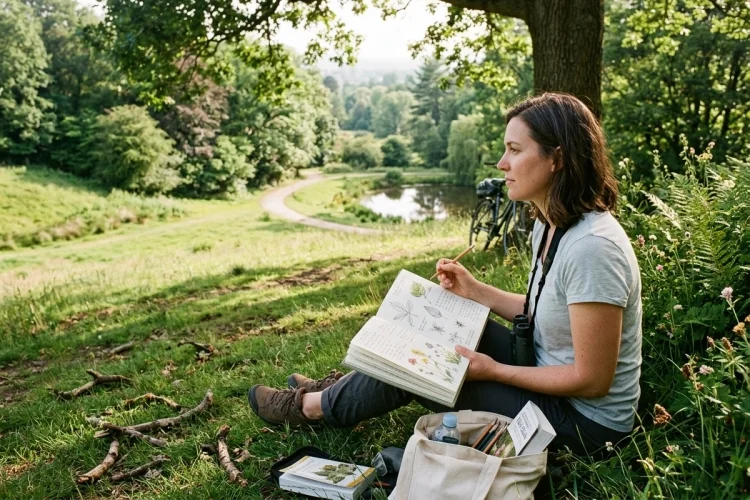
Have you ever walked past the same tree hundreds of times without really noticing it? Then one day, you stop and realize that new leaves have appeared, a bird is building a nest nearby, or tiny insects are moving across the bark.
That is exactly the kind of discovery a nature journal can help you make.
Learning how to start a nature journal is less about becoming a professional artist or scientist and more about slowing down and paying attention.
A nature journal is simply a personal record of what you observe outdoors-or even through a window. You can combine notes, sketches, questions, measurements, weather details, and anything else that helps capture what you notice.
The National Park Service describes nature journaling as a way to focus awareness on the natural world and develop a deeper understanding through observation.
Best of all, you do not need expensive equipment or a wilderness adventure. A notebook, pencil, and curious mind are enough to begin.
What Is a Nature Journal?
A nature journal is a notebook used to record observations about the natural world.
Your entries might include birds visiting a garden, clouds moving across the sky, leaves changing color, insects appearing after rain, or flowers opening at different times of year.
There is no single correct format.
Some people mainly write. Others prefer drawing, diagrams, numbers, maps, or combinations of all of these.
National Park Service educational materials describe nature journaling as regular recording that may include observations, perceptions, feelings, drawings, writing, and scientific information.
This flexibility is what makes nature journaling so accessible.
You are not creating a polished textbook. You are creating a record of what caught your attention.
Start With a Simple Notebook and Pencil
Beginners sometimes make nature journaling unnecessarily complicated by buying lots of supplies before making their first observation.
Keep it simple.
A small notebook is ideal because you can carry it easily during walks, trips to the park, or time in the garden. Add a pencil, and you already have everything necessary.
The National Park Service suggests basic materials such as an unlined journal, pencil, pen, and colored pencils for nature-journaling activities.
Cornell Lab of Ornithology also notes that pocket-sized notebooks are useful for quickly recording observations in the field. Pencils can be particularly practical because they work in a range of outdoor conditions.
You can add colored pencils, binoculars, a ruler, or a magnifying glass later if you enjoy using them.
The journal itself matters much less than the habit of observing.
Record the Basic Details First
Every nature journal entry becomes more useful when it includes a little context.
Start by recording the date, time, location, and weather. The National Park Service includes these details as basic metadata for nature-journal entries, while Cornell recommends beginning field notes with similar information.
For example:
Saturday, 8:15 a.m. Local park. Warm, cloudy, light breeze.
That single line immediately gives context to everything that follows.
Then record what you notice.
Maybe there are fewer butterflies than yesterday. Perhaps birds are especially active after an early morning rain. Maybe one plant is flowering while another of the same species is still covered in buds.
Months later, those little details become surprisingly interesting because you can compare them with newer observations.
Use the “Notice, Wonder, Remind” Method
One of the easiest ways to avoid staring at a blank page is to use three simple prompts:
What do I notice? What do I wonder? What does this remind me of?
The National Park Service uses these ideas as part of its approach to nature journaling.
Imagine you are observing a butterfly.
You might write that its wings are orange with dark markings. Then you might wonder why it keeps returning to the same flower. Finally, the pattern on its wings might remind you of stained glass.
Suddenly, one small observation has produced description, curiosity, and personal connection.
Questions are especially valuable.
You do not need to know the answer immediately. Writing “Why are there more ants here than near the other tree?” gives you something to investigate later.
A good nature journal collects questions as enthusiastically as it collects answers.
Sketch What You See-Even If You Cannot Draw
Many beginners avoid nature sketching because they think their drawings need to look realistic.
They do not.
Sketching is primarily an observation tool.
When you attempt to draw a leaf, bird, flower, or insect, you naturally begin noticing details you might otherwise overlook: the angle of a stem, the shape of a beak, the number of petals, or the pattern of veins in a leaf.
Cornell Lab of Ornithology notes that incorporating sketching can strengthen observation because drawing requires people to slow down and study what they are seeing.
Start with basic shapes.
Draw an oval for a bird’s body, lines for branches, or simple outlines of leaves. Add arrows pointing toward interesting features and write notes beside them.
You can even write, “bright yellow here” instead of coloring the object.
The goal is not artistic perfection. It is accurate attention.
Choose a Regular “Sit Spot”
Constantly walking through nature is enjoyable, but staying still can reveal things you would otherwise miss.
Choose a comfortable place in your garden, park, balcony, schoolyard, or other familiar outdoor area. Sit quietly for 10 to 20 minutes and observe.
Cornell describes this practice as using a sit spot. Remaining quietly in one location can give wildlife time to become accustomed to your presence, allowing you to observe more natural behaviors.
At first, the place might seem quiet.
After several minutes, you may notice birds calling from different directions, insects moving through grass, leaves shifting in the wind, or clouds changing shape.
Record sounds as well as sights.
You could even make a simple sound map by putting yourself in the center of the page and marking where different noises originate.
Returning to the same sit spot regularly makes seasonal and environmental changes much easier to recognize.
Track Changes Over Time
One of the biggest advantages of keeping a nature journal is that isolated observations eventually become patterns.
Choose something you can revisit regularly.
It could be a tree, flower bed, pond, bird feeder, houseplant, or patch of weeds growing beside a sidewalk.
Record what changes each week.
When do new leaves appear? When does the plant flower? Which insects visit it? Does bird activity change with the weather?
National Park Service nature-journaling lessons specifically use repeated observation to help learners discover changes in nature over time.
After several months, you may find yourself documenting seasonal cycles without originally intending to.
Your ordinary notebook slowly becomes a record of your local environment.
Combine Words, Numbers, and Pictures
A nature journal does not need to resemble a diary.
Mix different types of information on the same page.
Suppose you are observing a sunflower. You might sketch its shape, measure its height, count the number of visible leaves, record the temperature, describe visiting insects, and write questions about its growth.
This combination encourages both creative and analytical thinking.
NAAEE describes nature journals as spaces for recording observations, thoughts, and feelings while supporting creativity, critical thinking, and scientific skills.
You can also compare objects.
Draw two leaves beside each other and note differences in size, texture, shape, damage, or color. Compare two birds visiting the same location or the appearance of the same tree before and after heavy rain.
Numbers can make observations even more useful.
Instead of writing “lots of bees,” try “seven bee visits in five minutes.”
Small measurements turn casual observations into simple field data.
Build a Routine You Can Actually Maintain
You do not need to journal every day.
Consistency is more valuable than frequency. A weekly 15-minute session is enough to begin noticing patterns.
Research summarized by NAAEE has explored regular nature journaling as a way to encourage time outdoors and environmental awareness, including a study in which college students returned weekly to a chosen nature site.
Try connecting journaling with something you already do.
Take your notebook during a weekend walk, spend ten minutes outside after breakfast, or make one journal entry every Sunday afternoon.
Keep the expectations small.
One sketch, three observations, and one question can be a complete entry.
When journaling feels like exploration rather than homework, you are much more likely to continue.
Remember That Everyday Nature Is Enough
You do not need dramatic wildlife or spectacular landscapes.
Nature journaling can happen almost anywhere.
NAAEE notes that nature journaling can include observations from houseplants, backyards, urban parks, playgrounds, and other everyday environments.
Look closely at weeds growing through pavement. Watch how rain collects on a window. Track the Moon, observe clouds, study ants near the doorstep, or follow the growth of a plant in a pot.
Ordinary subjects often become fascinating once you start paying attention.
That is one of the biggest lessons nature journaling teaches: interesting things were already happening around you.
You simply had to notice them.
Learning how to start a nature journal does not require artistic talent, scientific expertise, or expensive outdoor equipment. All you really need is a notebook, a pencil, and enough curiosity to slow down and observe.
Begin by recording the date, location, weather, and a few things you notice. Add questions, quick sketches, measurements, sounds, and comparisons whenever they help. Return to the same places regularly, and patterns will gradually become visible.
Your first journal entry does not need to be impressive.
Pick one tree, bird, cloud, flower, or insect today and spend five minutes studying it. Write down three things you notice and one thing you wonder.
That small observation can be the beginning of a completely different way of seeing the everyday natural world.