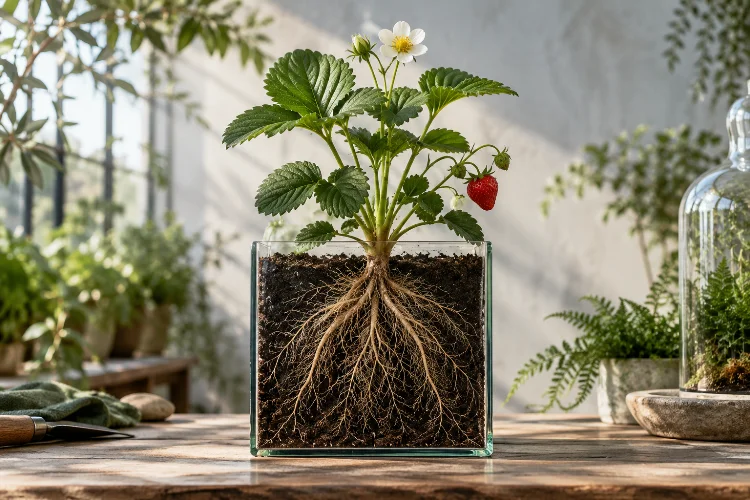
Look at almost any plant and you will see what appears to be a fairly simple living thing. There might be roots hidden underground, a stem growing upward, several leaves, and perhaps a few flowers or fruits.
But behind that simple appearance is a surprisingly organized system.
Every major plant part has a specific job. Roots collect water and minerals, stems provide support and transport materials, leaves produce food, while flowers, fruits, and seeds help plants reproduce and begin the next generation.
Understanding the main parts of a plant and their jobs is one of the easiest ways to begin learning basic botany. It also helps explain familiar things we see every day, from why plants wilt without water to why flowers eventually develop into fruits.
Botanists often group plant structures into vegetative parts, such as roots, stems, and leaves, and reproductive parts, including flowers, fruits, and seeds. Together, these plant organs allow a plant to survive, grow, and reproduce.
Roots: The Plant’s Underground Support System
Roots are usually hidden beneath the soil, so they are easy to forget. However, they perform several jobs that are essential for plant survival.
One of their most obvious functions is anchoring the plant in the ground. A strong root system helps keep a plant stable against wind, rain, and movement in the surrounding soil.
Roots also absorb water and dissolved minerals from the soil. Tiny structures near the roots increase the surface area available for absorption, helping the plant collect the resources it needs for growth.
According to Oregon State University Extension, roots primarily absorb moisture and nutrients, anchor plants, support stems, and can also store food.
Some plants are excellent examples of this storage function. Carrots, beets, and sweet potatoes store significant amounts of energy underground.
Plants can also have different types of root systems. Carrots have a prominent taproot, while grasses generally develop fibrous networks of many thinner roots.
Stems: Support and Transportation Highways
If roots are the foundation, stems are something like the plant’s support structure and transportation system.
Stems hold leaves, flowers, and fruits in positions where they can receive sunlight or interact with pollinators and the surrounding enviroment. They also help plants grow upward rather than remaining flat against the ground.
Inside many stems are specialized tissues called xylem and phloem.
Xylem transports water and minerals primarily from the roots upward through the plant. Phloem distributes sugars made during photosynthesis to areas where those sugars are needed or stored.
This means a stem is doing much more than simply keeping a flower upright.
Think about a tall sunflower. Water absorbed underground must somehow reach leaves positioned far above the soil. Its vascular system makes that movement possible.
Stems also come in surprisingly different forms. Tree trunks, grapevines, asparagus shoots, and even potato tubers are examples of stems or modified stem structures.
Leaves: The Plant’s Food-Making Centers
Leaves may be the most recognizable plant organs.
Their main job is closely connected with photosynthesis, the process through which plants use light energy to produce sugars.
Leaves contain cells with chloroplasts that capture light energy. Using water supplied through the plant and carbon dioxide from the air, plants produce sugars that can later be transported to roots, stems, fruits, and growing tissues.
This explains why many leaves are broad and relatively flat. That shape provides a large surface that can capture sunlight efficiently.
Leaves also contain tiny openings called stomata. These openings help regulate gas exchange between the plant and the surrounding air.
Not every leaf looks like the classic broad green leaf pictured in children’s books. Pine needles, cactus spines, succulent leaves, and the colorful bracts of some plants show how plant structures can be modified for different conditions.
Even with those variations, leaves remain closely connected to a plant’s ability to capture energy and survive.
Flowers: Helping Plants Reproduce
Flowers might look as though their main purpose is decoration, but biologically they have a much more important role.
Flowers contain structures involved in sexual reproduction. Depending on the plant, these structures produce pollen and ovules, and successful pollination can eventually lead to seed formation.
Many flowers have bright colors, scents, or nectar that attract animals such as bees, butterflies, birds, and other pollinators.
These visitors can carry pollen between flower structures, making fertilization possible.
Oregon State University Extension describes flowers as reproductive organs and notes that characteristics such as color and fragrance often function in attracting pollinators.
Not every flowering plant depends on animals. Some use wind or other mechanisms to move pollen.
Either way, flowers are closely connected to one of the biggest jobs any living organism has: producing the next generation.
Fruits: Protecting and Moving Seeds
When people hear the word “fruit,” they often imagine sweet foods such as apples, oranges, or strawberries.
Botanically, however, fruits have a wider meaning.
A fruit develops from flower structures after successful reproduction and typically contains or surrounds seeds. One important job of the fruit is to protect developing seeds.
Fruits can also help seeds travel away from the parent plant.
An animal might eat a berry and later deposit the seeds somewhere else. Other fruits attach to fur, float on water, or open when mature and release their seeds.
The University of Illinois Extension describes fruit as a plant structure that carries and protects seeds.
This botanical definition creates some fun surprises.
Tomatoes, peppers, cucumbers, and pumpkins are fruits because they develop from flowers and contain seeds, even though we often call them vegetables in the kitchen.
Seeds: The Beginning of a New Plant
A seed might look inactive, but inside it is the beginning of another plant.
Seeds contain an embryo that can eventually develop into roots, stems, and leaves when conditions become suitable. Many seeds also contain stored food that supports early growth before the young plant can make enough food through photosynthesis.
Water is often one of the first triggers for germination.
Once conditions are right, the seed absorbs moisture and the embryo begins developing. The young root commonly emerges first, followed by the shoot.
Different plants produce seeds with very different shapes, sizes, and survival strategies.
Some seeds germinate quickly. Others can remain dormant until suitable temperature, moisture, light, or other conditions are available.
This ability allows plants to reproduce even though the parent plant itself cannot walk somewhere new.
How All the Plant Parts Work Together
It is useful to study plant organs seperately, but no healthy plant depends on just one part.
Imagine a tomato plant.
Its roots absorb water and minerals from the soil. The stem carries those materials upward and supports the leaves.
The leaves use sunlight to produce sugars through photosynthesis. Those sugars can then move through phloem to growing roots, flowers, fruits, and other tissues.
Flowers allow reproduction to occur. After pollination and fertilization, fruits develop and protect the seeds that may eventually grow into new tomato plants.
Everything is connected.
If roots cannot obtain enough water, leaves may wilt. If leaves are badly damaged, the plant loses much of its food-making capacity. Without successful reproduction, flowering plants may fail to produce viable seeds.
A plant is therefore less like a collection of independent parts and more like a coordinated biological system.
You Probably Eat Plant Parts Every Day
One easy way to remember plant anatomy is to connect it with food.
A carrot is primarily a root. Celery is largely eaten for its leaf stalks, while asparagus is a young stem. Spinach and lettuce give us leaves.
Broccoli includes immature flower structures and stems. Tomatoes and cucumbers are fruits, while peas, beans, corn kernels, and sunflower seeds are examples of seeds we commonly eat.
University of Illinois Extension educational materials use similar everyday foods to show that people regularly consume roots, stems, leaves, flowers, fruits, and seeds.
Looking at dinner this way can turn an ordinary meal into a simple botany lesson.
Instead of simply seeing vegetables on a plate, you can ask which part of the plant each food actually represents.
Why Learning Plant Parts Matters
Knowing basic plant anatomy gives you a foundation for understanding much more than gardening.
It helps explain photosynthesis, plant reproduction, food production, ecosystems, agriculture, and even how plants respond to their surroundings.
Learning botanical vocabulary can also improve observation. NC State Extension notes that understanding plant terminology can help people notice differences in stems, leaves, buds, flowers, and other features that they might otherwise overlook.
Once you understand the basic structures, plants start becoming much more interesting.
A flower is no longer simply something colorful. A leaf is not just green decoration. Each structure becomes evidence of how the plant is solving the everyday problems of collecting resources, producing energy, growing, and reproducing.
The main parts of a plant may look simple, but every one has an important job.
Roots anchor the plant and collect water and minerals. Stems provide support and transport materials. Leaves use sunlight to make sugars, while flowers help with reproduction. Fruits protect and often help distribute seeds, and seeds carry the potential for an entirely new plant.
Most importantly, these structures work continously as one connected system rather than as independent pieces. The next time you see a garden plant, tree, flower, or vegetable, take a closer look.
Try identifying its roots, stem, leaves, flowers, fruits, or seeds and think about what each structure is doing. A few minutes of observation can turn an ordinary plant into a surprisingly interesting biology lesson.